
Should You foreclose loan or pay EMI? A Mathematical Guide
Highlights
EMI Calculator
It’s that time of the year. Maybe you’ve just received your Diwali bonus, a performance incentive, or perhaps a matured fixed deposit has hit your savings account. You are staring at a lump sum of cash, let’s say ₹5 Lakhs.
Naturally, the first thought that strikes every middle-class Indian mind is: “Should I clear off that burden on my head? Should I foreclose my loan?”
We are wired to hate debt. In our households, being “debt-free” isn’t just a financial status; it’s a character certificate. But hold on. Before you rush to the bank manager with a cheque, we need to sit down, sip some chai, and do the math.
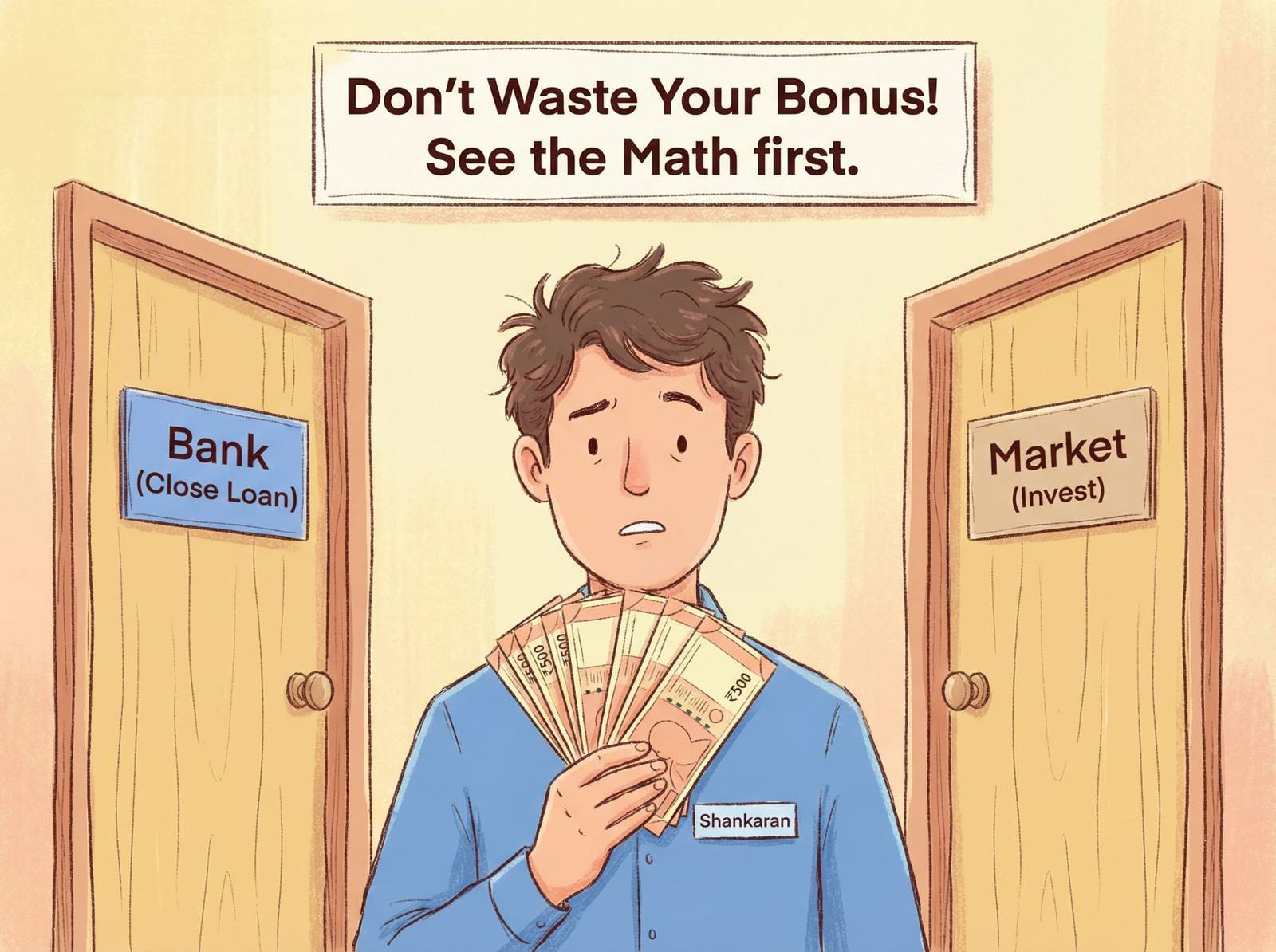
To make this simple, let’s introduce Shankaran Pillai from Kallakurichi. Shankaran is a methodical man, works in IT, and like many of us, he hates paying interest to the bank. But he also likes seeing his money grow.
Let’s solve Shankaran’s dilemma: Foreclose loan or pay EMI?
The Scenario: Shankaran’s Home Loan
Shankaran bought a nice apartment three years ago. Here is what his loan book looks like:
- Loan Amount: ₹40 Lakhs
- Tenure: 20 Years (240 Months)
- Interest Rate: 8.5% (Floating)
- EMI: ₹34,713
- Time Passed: 3 Years (36 EMIs paid)
The Windfall: Shankaran has received a lump sum of ₹5 Lakhs (Bonus + Savings).
He has two choices:
- Option A: Pay this ₹5 Lakhs into the loan account (Part-prepayment) to reduce the burden.
- Option B: Continue paying the regular EMI and invest this ₹5 Lakhs in a Mutual Fund.
Let’s break it down, strictly by the numbers.
Option A: The Magic of Foreclosure (Part-Payment)
Banks make the most money in the initial years of your loan. If you look at Shankaran’s amortization schedule, for the first few years, a huge chunk of his ₹34,713 EMI goes towards interest, not the principal.
If Shankaran pays ₹5 Lakhs directly towards the principal now (at the start of the 4th year):
- Outstanding Principal drops: From approx ₹37.8 Lakhs to ₹32.8 Lakhs.
- Impact: If he keeps the EMI same, his tenure slashes drastically.
The Result:
By paying ₹5 Lakhs now, Shankaran will finish his loan roughly 5 to 6 years early.
- Interest Saved: He saves approximately ₹18 Lakhs to ₹20 Lakhs in future interest payments over the life of the loan.
Verdict: This looks fantastic. He saves huge interest and becomes debt-free faster. He can sleep peacefully knowing the roof over his head is truly his.
Option B: The “Opportunity Cost” (Investing the Cash)
Now, let’s look at the gap in the strategy. What if Shankaran Pillai ignores the urge to close the loan? What if he tolerates the EMI and puts that ₹5 Lakhs into a diversified Equity Mutual Fund (Nifty 50 or Flexi Cap)?
Let’s assume a conservative return of 12% per annum over the remaining 17 years of his loan tenure.
- Investment: ₹5 Lakhs
- Time: 17 Years
- Rate of Return: 12%
The Result:
Using the power of compounding, that ₹5 Lakhs grows to approximately ₹34.3 Lakhs.
The Ultimate Comparison: Who Wins?
Let’s look at the Net Wealth Effect for Shankaran Pillai.
Scenario 1 (Foreclosing/Prepaying):
- He saves roughly ₹19 Lakhs in interest payments (money not paid is money earned).
- Total Benefit: ₹19 Lakhs.
Scenario 2 (Investing):
- He pays the full interest to the bank (Cost: -8.5%).
- He earns returns from the market (Gain: +12%).
- The final corpus generated is ₹34.3 Lakhs.
- Even after paying Capital Gains Tax (LTCG at 12.5% on profits), he is left with roughly ₹30 Lakhs.
Winner: Investing (Option B) leaves Shankaran richer by nearly ₹11 Lakhs compared to foreclosing.
Why?
Because the Return on Investment (12%) is higher than the Cost of Debt (8.5%). As long as your investment generates more percentage return than your loan interest rate, math dictates you should invest.
Wait! It’s Not Just About Math (The Indian Context)
While Excel sheets say “Invest,” life in a Tier-2 city like Kallakurichi or a metro like Mumbai isn’t lived on spreadsheets. There are other critical factors Shankaran must consider before deciding.
1. The Tax Shield (Section 24b)
If Shankaran forecloses the loan, he loses the tax benefit.
Under Section 24(b) of the IT Act, Shankaran can claim a deduction of up to ₹2 Lakhs per year on home loan interest.
- If he is in the 30% tax bracket, this deduction saves him about ₹60,000 in taxes every year.
- The effective interest rate of his loan isn’t 8.5%; it’s actually closer to 6% after factoring in tax savings.
- Point: This makes the gap between “Loan Cost” and “Investment Return” even wider, favoring investment.
2. Liquidity is King
Imagine Shankaran pays the ₹5 Lakhs to the bank. The next month, there is a medical emergency in the family, or his car breaks down.
- Can he ask the bank for that ₹5 Lakhs back? No.
- If he had invested in Mutual Funds, he could redeem the money within 3 days.
- Lesson: Never use your emergency fund to foreclose a loan. Only use surplus cash.
3. The “Prepayment Penalty” Trap
Shankaran is lucky because he has a Floating Rate Home Loan.
- RBI Rule: Banks cannot charge a prepayment penalty on floating-rate home loans taken by individuals.
- However, if Shankaran had a Fixed Rate Loan or a Personal Loan, the bank might charge 2% to 4% as a foreclosure fee. Always check the fine print!
4. The “Sleep Well” Factor
This is the most important Indian metric.
Does Shankaran worry about his job security? Does the thought of EMI make him anxious?
- If Shankaran is risk-averse, nearing retirement, or just hates debt, Foreclosure is the right choice.
- Math cannot calculate the joy of a debt-free life. If closing the loan reduces his stress, that is worth more than the ₹11 Lakhs extra profit.
The Verdict: What Should Shankaran Do?
Here is a simple cheat sheet for Shankaran (and you) to decide:
| Situation | Recommendation |
| Loan Interest is High (>11%) <br> (Personal Loans, Credit Card Debt) | FORECLOSE IMMEDIATELY. No investment guarantees 15-20% returns. Kill this loan first. |
| Loan Interest is Low (<9%) <br> (Home Loans) | INVEST. Put the surplus in SIPs. You will beat the loan interest in the long run. |
| Early Stage of Loan (First 5 Years) | PART-PAY IF RISK-AVERSE. Prepayment impacts the principal most in the early years. |
| Late Stage of Loan (Last 5 Years) | DO NOT FORECLOSE. You are mostly paying principal now; the interest damage is already done. Keep the cash. |
| Job Security is Low | HOARD CASH. Do not pay off the loan. Keep the liquidity for survival. |
How to Calculate Your Own Savings?
Shankaran’s numbers are specific to him. Your loan amount and tenure will differ. You don’t need a Chartered Accountant to figure this out.
We have created a simple tool where you can plug in your numbers—Loan Amount, Interest Rate, and Prepayment Amount—to see exactly how many years you save.
👉 Check your savings now with our EMI Calculator
Conclusion
So, Shankaran Pillai sat down, looked at the numbers, and made a decision. Since he is young (32 years old) and has a stable job, he decided to invest the ₹5 Lakhs in a diversified equity fund. He realized that over 15 years, this money would work harder for him in the market than it would sitting in the bank’s locker.
However, if this was his father, who is 58 and retiring soon, the advice would be the opposite: Kill the loan, secure the home.
Finance is personal. The “right” answer depends on whether you want to maximize wealth or maximize peace of mind.
What would you do with the ₹5 Lakhs? Let us know in the comments!