
5 Smart Ways to reduce home loan EMI Burden in 2026
Highlights
EMI Calculator
We Indians have a very emotional relationship with buying a house. It’s not just concrete and bricks; it is a status symbol, a safety net, and the ultimate middle-class dream. Whether you are in a high-rise in Mumbai or building a duplex in Kallakurichi, the feeling is the same.
But here is the bitter truth that hits you a month after the Griha Pravesh (housewarming) ceremony: The EMI.
Let me introduce you to Shankaran Pillai, a hardworking government employee from Kallakurichi. Shankaran took a home loan of ₹50 Lakhs for 20 years at an interest rate of 8.5%. He was happy he got the loan sanctioned. But he didn’t do the math. By the end of 20 years, Shankaran would have paid the bank back not ₹50 Lakhs, but over ₹1.04 Crores. He is paying more in interest than the actual cost of the house!
If you are reading this, chances are you are feeling the same pinch. The RBI Repo rates keep fluctuating, and suddenly that manageable EMI feels like a burden.
Don’t worry. You don’t have to suffer for 20 or 30 years. There are smart, mathematical ways to hack this system. Here is how you can reduce your home loan EMI burden and save lakhs in the process.
1. The “One Extra EMI” Magic Trick
This is the most powerful tool in your arsenal, yet most people ignore it because they think, “I can’t afford to pay more.”
Let’s look at the numbers.
If Shankaran Pillai decides to pay just one extra EMI every year, the magic of compound interest works in his favour. It doesn’t have to be a lump sum. You can simply divide your monthly EMI by 12 and add that small amount to your monthly payment.
How it works:
When you make a prepayment, the amount goes directly towards reducing your Principal Amount, not the interest. Since interest is calculated on the outstanding principal, a lower principal means lower interest next month.
- Scenario A: You pay normal EMI for 20 years.
- Scenario B: You pay 1 extra EMI per year.
Result: In Scenario B, you could close your loan in roughly 16 to 17 years instead of 20. That is 3 years of freedom! That is 3 years of salary you can save for your daughter’s wedding or your retirement.
Actionable Tip: If your bank doesn’t allow monthly variation, open a recurring deposit (RD) for that small amount, and once a year, use that maturity amount to make a part-payment.
2. Home Loan Balance Transfer (The Switch)
You wouldn’t buy vegetables from a vendor selling onions at ₹80/kg if the vendor next to him is selling them at ₹60/kg, right? You would switch immediately. Why not do the same with your loan?
Banks are always competing for customers with good credit scores (CIBIL 750+). If your current lender is charging you 9.25% but a competitor is offering 8.50%, it might look like a small difference, but over 15 years, it is huge.
Let’s calculate:
On a ₹50 Lakh loan for 20 years:
- At 9.25%: Total Interest = ₹59 Lakhs.
- At 8.50%: Total Interest = ₹54 Lakhs.
That is a straight saving of ₹5 Lakhs—enough to buy a decent small car or renovate your kitchen!
Warning on Charges:
Before you jump, check the home loan balance transfer charges. Processing fees usually range from 0.5% to 1% of the loan amount. Do a cost-benefit analysis. If the savings are significantly higher than the switching cost, go for it.
3. Increase EMI, Don’t Increase Tenure
This is a classic trap banks set for you. When interest rates rise (as they did in 2023-24), banks will often call you and say, “Sir/Ma’am, to keep your monthly burden low, we have increased your tenure from 20 years to 25 years.”
It sounds like they are helping you. They are not. They are ensuring you stay in debt forever.
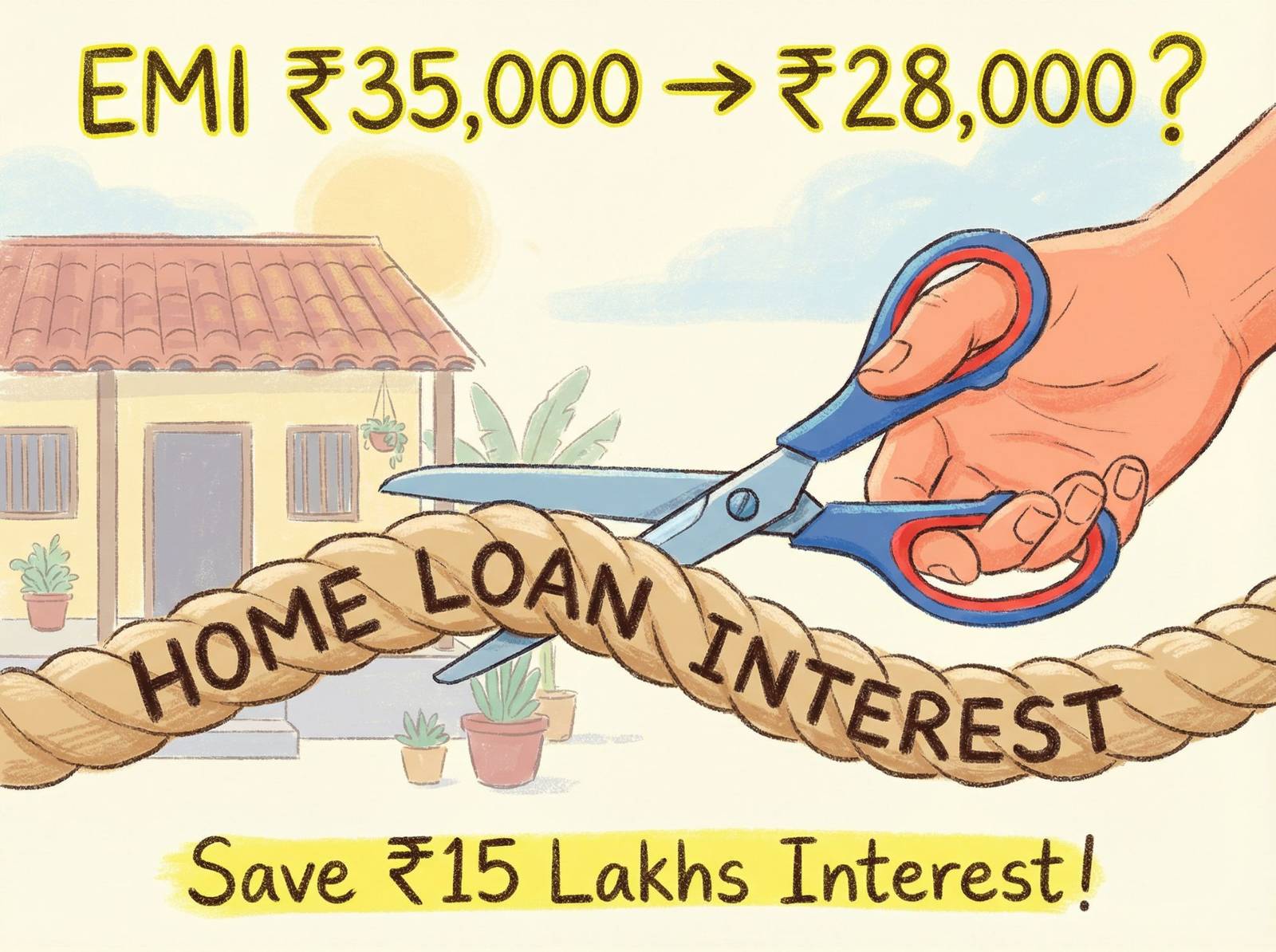
Shankaran Pillai faced this. When rates went up, his bank extended his tenure. He thought, “At least my monthly expense is same.” But in reality, he signed up to pay an extra ₹15 Lakhs in interest over the long run.
The Strategy:
Whenever you get a salary hike—be it an annual appraisal or a promotion—increase your EMI by a proportional amount. Even a 5% increase in your EMI every year can slash your tenure by almost 40%.
Treat your EMI like your lifestyle inflation. As your income grows, your repayment speed should grow too.
4. Utilize Windfall Gains (The Diwali Bonus Strategy)
We Indians love our festivals and the bonuses that come with them. Whether it’s a Diwali bonus, a performance incentive, or maturity from an old LIC policy, our instinct is to spend it on gadgets, gold, or a vacation.
I am not saying you shouldn’t enjoy your life. But consider the 80/20 rule.
Use 20% of that bonus for enjoyment and funnel 80% of it into your home loan prepayment.
Why?
Early prepayments reduce the principal when the interest component is highest.
- Early in the loan (Years 1-5): Most of your EMI is just interest.
- Late in the loan (Years 15-20): Most of your EMI is principal.
Throwing money at the loan in the first 5 years has a 10x impact compared to the last 5 years. Shankaran Pillai made the mistake of prepaying in the 18th year—it hardly made a difference. Don’t be like Shankaran. Strike while the iron is hot (in the initial years).
5. Switch to a Repo-Linked Lending Rate (RLLR)
If you took your loan many years ago, you might still be on the MCLR (Marginal Cost of Funds Based Lending Rate) or even the old Base Rate system. These regimes are often slower to pass on interest rate cuts to the consumer.
The RBI introduced the Repo Linked Lending Rate (RLLR) to ensure transparency. Under this, if the RBI cuts the repo rate, your home loan interest rate must come down almost immediately.
Check your loan statement. If you are not on an external benchmark linked rate (EBLR/RLLR), visit your branch manager tomorrow. Submit a simple application to convert your loan. There might be a small conversion fee (usually ₹5,000 to ₹10,000 plus GST), but it aligns your loan with market realities.
Common Mistakes to Avoid
While trying to reduce your burden, don’t fall into these pits:
- Using Emergency Funds: Never use your medical emergency fund to prepay your home loan. If a health crisis hits, a paid-off house won’t pay the hospital bills. Liquid cash is King.
- Ignoring Tax Benefits: Remember, under Section 24(b), you get tax deductions on interest payment up to ₹2 Lakhs. Under Section 80C, principal repayment is deductible up to ₹1.5 Lakhs. If you aggressively prepay, your tax benefits might reduce. Consult your CA to find the sweet spot.
- Taking a Personal Loan to Pay Home Loan: This is financial suicide. Personal loans charge 11-16% interest. Never swap a cheap debt (home loan) for an expensive debt (personal loan).
Conclusion
Reducing your home loan EMI isn’t about starving yourself or stopping your family vacations. It is about being smarter than the bank.
Imagine the day you walk into the bank to collect your property documents, years ahead of schedule. Imagine the relief of having that extra ₹30,000 or ₹40,000 in your hand every month because you don’t have an EMI anymore.
Shankaran Pillai is now using these strategies. He increased his EMI by 5% this year and used his Pongal bonus to make a prepayment. He is on track to close his loan 4 years early.
What about you? Start with just one extra EMI this year. Your future self will thank you.
Frequently Asked Questions (FAQs)
Q1: Is it better to reduce EMI or reduce Tenure when making a prepayment?
Ans: Always choose to reduce tenure. Reducing tenure saves you lakhs in interest. Reducing EMI only gives you short-term monthly relief but keeps the total interest burden high.
Q2: Are there penalties for prepaying home loans in India?
Ans: As per RBI guidelines, there are zero prepayment penalties for floating rate home loans for individual borrowers. However, if you have a fixed-rate loan, lenders may charge a penalty. Always check your loan agreement.
Q3: How much CIBIL score is needed for a Balance Transfer?
Ans: Generally, a score of 750 or above is required to get the best interest rates during a balance transfer. If your score is lower, the new bank may not offer you a competitive rate.
Q4: Should I use my EPF to pay off my Home Loan?
Ans: You can withdraw from EPF for home loan repayment after 10 years of service, but think twice. EPF gives you a high, safe return for retirement. Only use it if the home loan interest rate is significantly higher than the EPF interest rate.