
SIP vs RD: 5 Reasons Why SIP Beats Recurring Deposits (2026 Comparison)
Highlights
Introduction: The “Safe” Bet That Is Costing You Money
Shankaran Pillai loves the Post Office.
Every month, rain or shine, he walks to the counter and deposits ₹5,000 into his 5-Year Recurring Deposit (RD). He loves seeing the entry in his passbook. It feels solid. It feels safe. “The bank gives me 6.7%,” he tells his friends proudly. “Guaranteed!”
But Shankaran is missing the invisible thief standing right behind him: Inflation.
If the price of milk, school fees, and petrol is rising by 6% every year, and his RD is giving him 6.7% (which is then taxed!), his “real” profit is effectively zero. He is running on a treadmill—sweating hard but going nowhere.
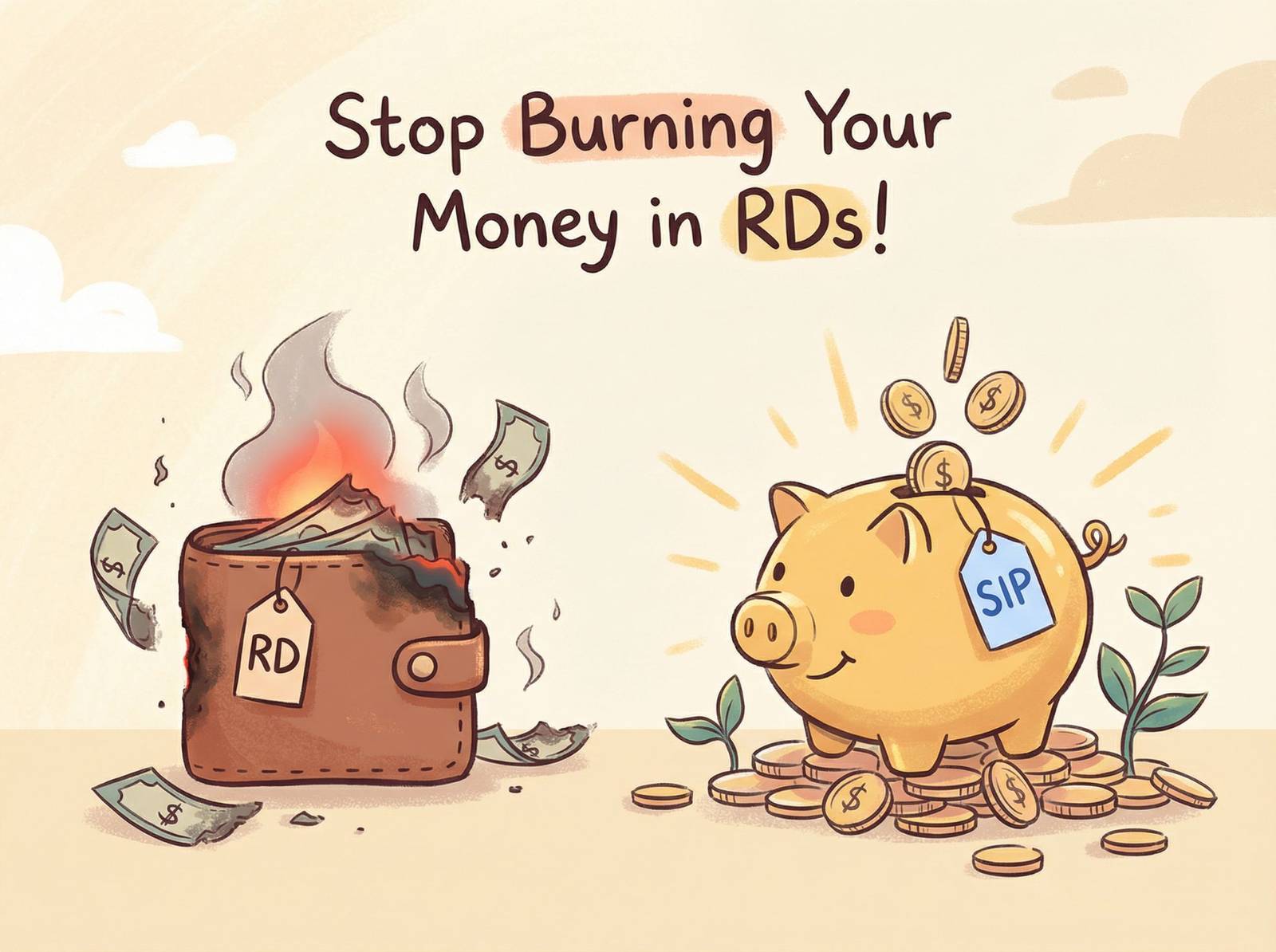
If you are stuck in the “RD Trap” like Shankaran, here are 5 mathematical reasons why you should consider switching to a Systematic Investment Plan (SIP) in Mutual Funds today.
SIP vs. RD: The “At a Glance” Comparison
Before we dive into the reasons, let’s look at the raw numbers.
| Feature | Bank/Post Office RD | SIP (Equity Mutual Fund) |
| Safety | High (Guaranteed returns) | Moderate (Market-linked) |
| Average Returns | 6.5% – 7.5% | 12% – 15% (Long Term) |
| Inflation Protection | Fail (Barely covers it) | Pass (Beats it significantly) |
| Taxation | Taxed as per your Income Slab (up to 30%) | 12.5% only on profit above ₹1.25L |
| Penalty | Penalty on premature withdrawal | No penalty (Exit load < 1 year) |
The Ultimate Guide to SIP Investment in India: Everything You Need to Know
Reason 1: The “Inflation Beater” Advantage
Is RD safe? Yes. Is it wealthy? No.
Let’s say you want to buy a car in 5 years. The car costs ₹5 Lakhs today. Due to inflation (price rise), that same car will cost approximately ₹6.7 Lakhs in 5 years.
- The RD Problem: Your RD interest barely keeps up with the car’s price hike. You save, but your purchasing power stays the same.
- The SIP Solution: Equity Mutual Funds invest in companies. As prices rise, companies earn more, and their stock prices go up. Historically, equity acts as a hedge against inflation.
Shankaran’s Reality Check:
While his RD money grew by 35% in 5 years, the cost of his daughter’s engineering college fees grew by 50%. He is actually poorer than when he started.
Reason 2: The Massive Difference in Returns (The Math)
Let’s stop talking theory and look at the wallet.
Imagine Shankaran and his smart neighbour, Vivek, both invest ₹10,000 per month for 10 years.
- Shankaran (RD at 7%):
- Total Invested: ₹12 Lakhs
- Maturity Value: ₹17.3 Lakhs
- Profit: ₹5.3 Lakhs
- Vivek (SIP at 12%):
- Total Invested: ₹12 Lakhs
- Maturity Value: ₹23.2 Lakhs
- Profit: ₹11.2 Lakhs
Result: Vivek made Double the Profit (₹11.2L vs ₹5.3L) with the exact same salary sacrifice.
How to Use a SIP Calculator to Plan Your ₹1 Crore Goal
Reason 3: Taxation (Keep More of What You Earn)
The government loves RDs almost as much as Shankaran does. Why? Because they tax it heavily.
The RD Tax Trap:
Interest earned on an RD is added to your annual income.
- If Shankaran earns ₹15 Lakhs a year, he is in the 30% tax bracket.
- That means out of his 7% RD return, the government takes 30%.
- Effective Return: ~4.9%. (This is below inflation!)
The SIP Tax Benefit:
For Equity SIPs, gains up to ₹1.25 Lakh per year are 100% Tax-Free.
- Even if you make a huge profit above ₹1.25 Lakh, you only pay 12.5% tax (Long Term Capital Gains).
- Compared to the 30% slab, this is a massive saving.
Reason 4: No Penalties on Stopping
Life happens. Maybe you have a medical emergency, or maybe you lose your job.
- RD: If you stop paying your installments or break the RD before maturity, the bank charges a penalty (usually 1%) and reduces the interest rate paid to you.
- SIP: There is no penalty for stopping a SIP. You can simply hit “Pause” in your app. If you need the money, you can withdraw it (subject to a small exit load only if withdrawn within 1 year). It is your money; you control it.
Reason 5: The “Rupee Cost Averaging” Safety Net
Shankaran is scared of the stock market because he thinks he has to “time” it. “What if I buy when the market is high?” he asks.
SIPs solve this automatically.
- When the market is Red (Down), your SIP installment buys More Units (Cheap).
- When the market is Green (Up), your SIP installment buys Fewer Units (Expensive).
Over time, your cost averages out. In an RD, you don’t get this benefit—you just get a flat rate regardless of the economic boom.
Conclusion: It’s Time to Upgrade Your Savings
We are not saying RDs are bad. They are great for short-term goals (like saving for a holiday in 6 months).
But for long-term wealth—retirement, children’s education, or buying a house—an RD is like riding a bicycle on a highway. It is safe, but it is too slow to get you to your destination.
Don’t be like the old Shankaran. Be the smart investor who uses the power of equities to beat inflation.
Ready to see how much faster you can reach your goals?