
Planning a SIP for Child Education: Don’t Let Fees Scare You
Highlights
SIP Calculator
The Shankaran Pillai Realization: Why You Need to Start Now
Let me introduce you to my good friend, Shankaran Pillai from Kallakurichi, Tamil Nadu.
Last week, Shankaran was the happiest man in the district. He became a father to a beautiful baby girl, Ananya. He distributed sweets to the entire street and even promised a biryani party to his colleagues. But yesterday, I found him sitting at our local tea stall, staring blankly at a newspaper clipping about private engineering college fees.
“What happened, Shankaran? The baby is sleeping well, no?” I asked.
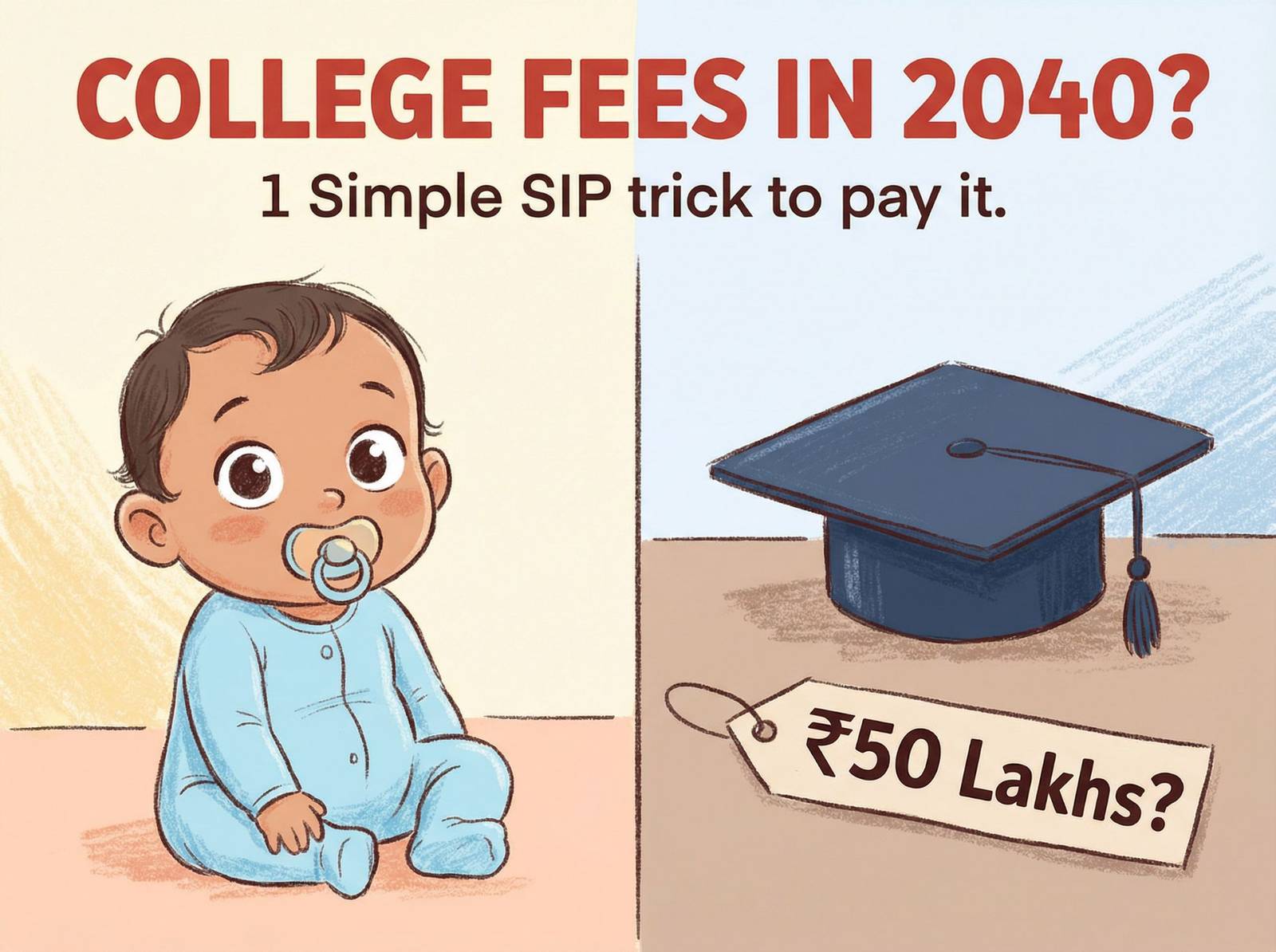
He looked at me and said, “She is sleeping, but I have lost mine. I just calculated that if an Engineering degree costs ₹10 Lakhs today, it will cost ₹40 Lakhs when Ananya turns 18. How will a middle-class man like me arrange ₹40 Lakhs? I don’t want her to start her life with an education loan hanging over her head.”
Shankaran’s panic is valid. In India, we obsess over the price of petrol and onions, but we often ignore Education Inflation. While general inflation hovers around 6%, the cost of education in India rises by about 10-12% every year.
If you are a new parent aged 30-35, you are standing at the exact same crossroad as Shankaran. You have two choices: hope for a miracle, or start a SIP for Child Education today.
Let’s put away the panic and bring out the calculator.
The Scary Math: Education Inflation in India
Let’s be practical. We love to save in India. We put money in savings accounts, we buy gold jewellery, and we open recurring deposits (RDs). But are these instruments enough to beat the “MBA cost future value”?
Here is a reality check on how much current courses might cost after 15-18 years, assuming a conservative 10% inflation rate.
| Education Goal (Today’s Cost) | Cost in 15 Years (Approx) | Cost in 20 Years (Approx) |
| Engineering (₹10 Lakhs) | ₹41.7 Lakhs | ₹67.2 Lakhs |
| Medical/MBBS (₹25 Lakhs) | ₹1.04 Crores | ₹1.68 Crores |
| Top Tier MBA (₹20 Lakhs) | ₹83.5 Lakhs | ₹1.34 Crores |
Note: These figures are estimates based on current trends in private institutions.
When Shankaran saw this table, he nearly dropped his tea glass. “One Crore for a doctor? I have to sell my ancestral land!” he exclaimed.
This is where the Systematic Investment Plan (SIP) comes in as your shield. You don’t need a lump sum today. You just need the discipline to set aside a small portion of your salary every month.
Why Your FD and Savings Account Will Fail You
Most of our parents swore by Fixed Deposits. And honestly, in their time, FDs gave 12% interest. Today, FDs give around 6.5% to 7% (pre-tax).
If education costs are rising at 10% and your money is growing at 7%, you are actually losing purchasing power every single year. This is negative real return.
To beat a 10% target, you need an asset class that can generate 12-15% over the long term. For investing for children, especially for long term goals (10+ years), Equity Mutual Funds are the only vehicle that consistently beats inflation in India.
The Blueprint: How to Build a ₹20 Lakh Corpus
Let’s solve Shankaran’s immediate problem. He wants to ensure he has at least ₹20 Lakhs ready for Ananya’s undergraduate degree when she turns 18.
He thinks he needs to save ₹10,000 or ₹15,000 a month, which is tough on his current salary. But the magic of compounding says otherwise.
The Calculation
- Target Amount: ₹20,000,000 (20 Lakhs)
- Time Horizon: 18 Years
- Expected Return: 12% (Conservative Equity MF average)
Monthly SIP Required: Approximately ₹2,600.
Yes, you read that right. Less than the cost of a family dinner at a nice restaurant or a weekend trip.
If Shankaran can stretch his budget and invest ₹5,000 per month, here is what happens:
- Total Invested: ₹10.8 Lakhs
- Wealth Gained: ₹27.6 Lakhs
- Total Corpus: ₹38.4 Lakhs
By starting early, Shankaran Pillai doesn’t just meet the goal; he doubles it. This is why starting a SIP for Child Education when the child is an infant is the smartest financial move you can make.
Sukanya Samriddhi vs Mutual Fund: The Great Debate
Shankaran’s neighbor, a government employee, insisted he open a Sukanya Samriddhi Yojana (SSY) account. “It is safe, Shankaran! Government guarantee!”
Let’s compare the two.
| Feature | Sukanya Samriddhi Yojana (SSY) | Equity Mutual Fund (SIP) |
| Safety | High (Govt Backed) | Moderate (Market Linked) |
| Returns | ~8.2% (Fixed/Variable) | ~12-15% (Long Term) |
| Liquidity | Locked until age 21 (Partial at 18) | Liquid (Exit load may apply) |
| Taxation | Tax-Free (EEE) | LTCG Tax (12.5% on gains above ₹1.25L) |
| Usage | Girl Child Only | Any Child (Boy/Girl) |
The Verdict:
SSY is excellent for the debt component of your portfolio because it is safe and tax-free. However, it will unlikely beat education inflation alone.
My Advice: Don’t choose one. Use a 60:40 ratio.
- Put 40% of your savings in SSY (for safety/marriage/assured minimal education costs).
- Put 60% in Equity Mutual Funds (to chase the high returns needed for tuition fees).
Where Should You Invest? (The Strategy)
You don’t need to be a stock market expert. You just need a simple plan.
1. For the Newborn (0-5 Years Old)
- Time to Goal: 15+ Years.
- Risk Capacity: High.
- Fund Choice: Small Cap or Mid Cap Funds.
- Why: You have time to ride out market volatility. These funds can deliver 15%+ returns over 15 years.
2. For the School-Goer (6-12 Years Old)
- Time to Goal: 8-10 Years.
- Risk Capacity: Moderate.
- Fund Choice: Flexi-Cap Funds or Large & Mid Cap Funds.
- Why: These funds balance stability with growth.
3. The “Late Starter” (13+ Years Old)
- Time to Goal: < 5 Years.
- Risk Capacity: Low.
- Fund Choice: Aggressive Hybrid Funds or Balanced Advantage Funds.
- Why: You cannot risk the capital dropping right before you pay the fees.
Step-by-Step Action Plan for Parents
Stop overthinking and start execution. Here is your checklist:
- Get Documents Ready: You need your PAN, Aadhar, and a bank account. You can open a folio in your name (Simpler) or the child’s name (Needs more paperwork, but legally separates the assets).
- Define the Goal: Are you saving for a B.Tech in Chennai or an MS in the USA? The corpus requirement changes from ₹20 Lakhs to ₹1 Crore. Be realistic.
- Start Small, Step Up: Start with ₹3,000/month. Every year, when you get an appraisal/increment, increase the SIP by 10%. This is called a Step-up SIP. It works wonders.
- Review Annually: Once a year, sit down (preferably with a cup of chai) and check if your fund is performing better than the category average.
Final Thoughts: Give Them Wings, Not Debt
Shankaran Pillai felt a heavy weight lift off his chest after seeing the numbers. He realized that the monster wasn’t the “fees in 2035,” but his own inaction in 2026.
We Indian parents will do anything for our children. We wear old clothes so they can wear new ones. We skip vacations to pay for their coaching classes. But the greatest gift you can give your child is the freedom to choose their career without looking at the price tag.
When your son or daughter comes to you at age 18 with an admission letter from a top university, you should be able to smile and say, “Go ahead, I’ve got this covered.” You shouldn’t have to walk into a bank manager’s cabin to beg for a loan.
Start your SIP for Child Education today. The best time was yesterday; the second best time is now.