
No Cost EMI Meaning Exposed: Hidden Charges You Must Know
Highlights
EMI Calculator
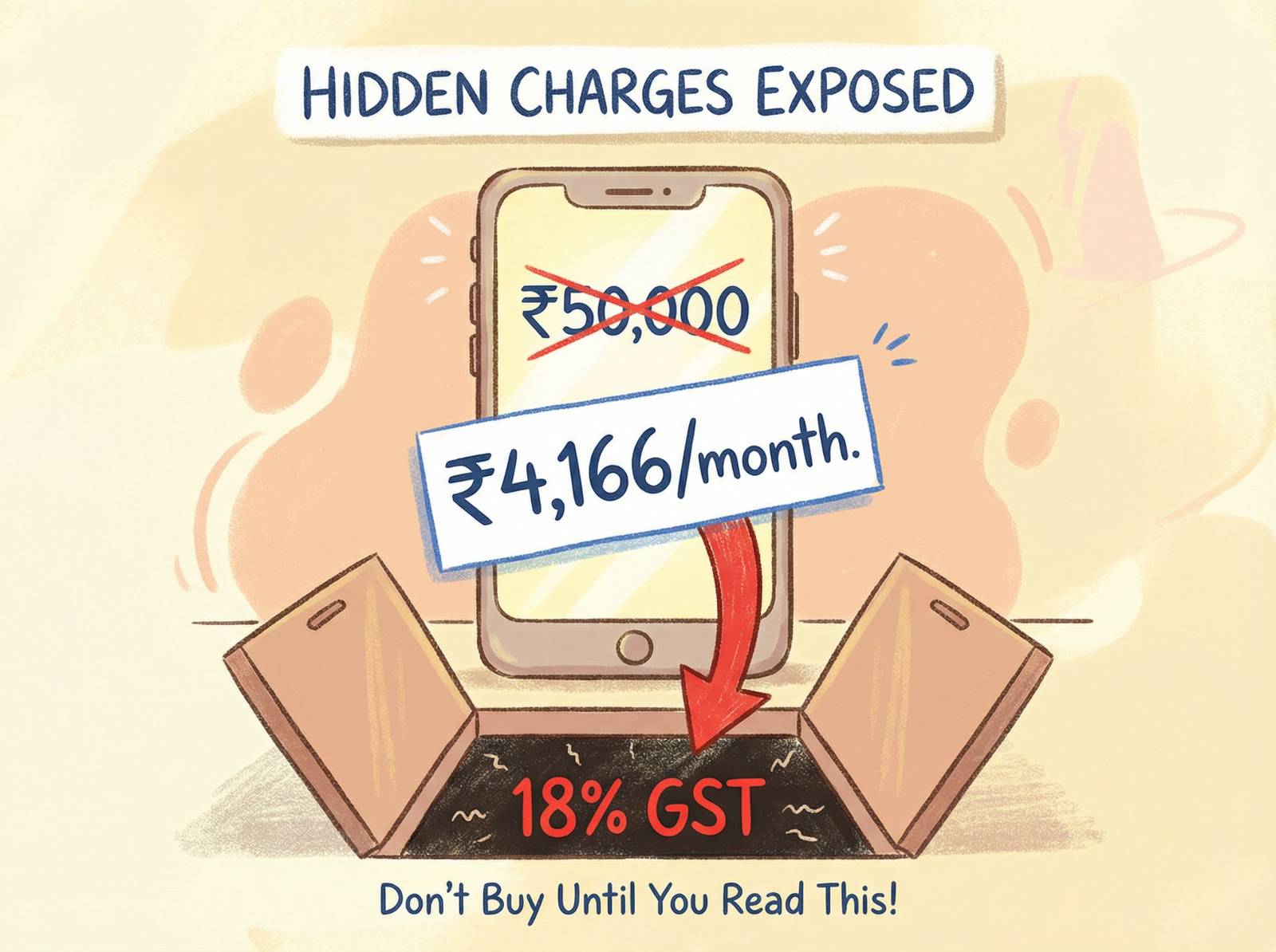
We have all been there. You are scrolling through Amazon or Flipkart during the Great Indian Festival or Big Billion Days. You spot that flagship phone you have been eyeing for months. The price tag is a hefty ₹50,000.
Your brain says, “Budget illa (no budget).”
But then, you see those three magical words in green text: No Cost EMI.
Suddenly, the math changes. It’s not ₹50,000 anymore. It is just ₹4,166 per month. The listing screams “Zero Interest!” and “No Down Payment!” It feels like the bank is doing you a favour, handing you free money just because you are a loyal customer.
But hold on. As my old school teacher used to say, “There is no free lunch in this world, not even at the temple annadhanam line if you cut the queue.”
To understand the real No Cost EMI meaning, we need to look past the marketing banners. We need to look at the bank statement of our friend, Shankaran Pillai from Kallakurichi.
Shankaran thought he beat the system. Instead, he paid nearly ₹2,500 extra for a phone he thought he was getting interest-free. Let’s break down exactly how this “E-Commerce Trap” works.
What is No Cost EMI? ( The Marketing Version)
On paper, the concept is simple. If you buy a washing machine for ₹30,000 on a 3-month No Cost EMI plan, you pay exactly ₹10,000 per month for three months.
Total paid: ₹30,000.
Interest paid: ₹0.
It sounds perfect for the middle-class Indian household where managing monthly cash flow is more important than the total capital. It allows you to buy premium gadgets without emptying your savings account instantly.
But if banks are in the business of making money, why would they lend you ₹30,000 for free? They aren’t charities. The truth is hidden in the fine print.
The RBI Intervention: Why “Zero Interest” Doesn’t Exist
A few years ago, the Reserve Bank of India (RBI) looked at these schemes and said, “This is not transparent.” They effectively banned absolute 0% interest schemes because banks cannot lend money without charging interest—it’s against the basic principles of banking.
So, how do Amazon, Flipkart, and banks like HDFC, SBI, or ICICI still offer it?
They use a workaround called “Discount in Lieu of Interest.”
Here is the mechanism:
- The Bank does charge you interest (usually 15% to 16% per annum).
- The Seller (or Brand) gives you an upfront discount on the product equal to that interest amount.
- You pay the “discounted price” + “interest,” which totals the original sticker price.
To you, it looks like the total is the same. But this accounting jugglery triggers a chain reaction of hidden costs.
The Shankaran Pillai Case Study: The Math Behind the Trap
Let’s go to Kallakurichi and meet Shankaran Pillai. He is a smart guy, works in a private firm, and wants to upgrade to a premium smartphone priced at ₹50,000. He chooses a 6-month No Cost EMI plan.
Let’s compare two scenarios: Paying Cash vs. The “Free” EMI.
Scenario 1: The Cash Payment (Smart Buyer)
If Shankaran had cash (or saved up for two months), he might notice that many credit cards offer an “Instant Discount” for full payments.
- Phone Price: ₹50,000
- Instant Cash Discount (often 5-10%): ₹2,500
- Final Price Paid: ₹47,500
Scenario 2: The No Cost EMI (The Trap)
Shankaran chooses the EMI option on his credit card. The interest rate is roughly 15% p.a. For 6 months, the interest comes to approximately ₹2,200.
Here is what happens on the invoice:
- Phone Price: ₹50,000
- Less Pre-applied Discount (equal to interest): (-) ₹2,200
- Invoice Amount Charged to Loan: ₹47,800
- Interest You Pay to Bank: (+) ₹2,200
- Total Principal + Interest: ₹50,000.
“See!” Shankaran says. “I paid ₹50,000. Same as the sticker price. No loss!”
Wrong, Shankaran. Here come the hidden charges.
The 3 Hidden Costs You Didn’t See
1. The GST Hit (18% on Interest)
This is the biggest No Cost EMI hidden charge that nobody talks about until the bill arrives.
In India, the government charges 18% GST on financial services. While the seller gave Shankaran a discount to cover the interest, they did not cover the GST on that interest. The bank will bill this directly to Shankaran.
- Interest Amount: ₹2,200
- GST on Interest (18%): ₹396
Shankaran has to pay this ₹396 from his own pocket. It is not part of the EMI; it is added to the monthly credit card bill.
2. The Processing Fee
Most major banks charge a one-time processing fee to convert a purchase into an EMI.
- Average Fee: ₹199 + GST = ₹235.
Some banks charge even more, up to ₹499 for high-value transactions.
3. The Foregone Discount (Opportunity Cost)
Remember Scenario 1? If Shankaran had paid fully, he might have got a ₹2,500 instant discount. By choosing No Cost EMI, he is ineligible for that specific “Full Swipe” offer.
So, he lost the chance to save ₹2,500 to gain the convenience of paying later.
The Final Tally: How Much Did Shankaran Actually Pay?
Let’s total up the damage for our friend in Kallakurichi.
| Cost Component | Amount (₹) | Notes |
|---|---|---|
| Product Price | ₹50,000 | The sticker price |
| GST on Interest | + ₹396 | 18% of the interest component |
| Processing Fee | + ₹235 | ₹199 + GST charged by Bank |
| Total Cash Outflow | ₹50,631 | You paid ₹631 extra |
| Lost Savings | + ₹2,500 | Discount missed by not paying upfront |
| Real Cost to Buyer | ₹53,131 | Effective Cost |
The Reality: Shankaran thought he was getting a free loan. In reality, compared to a savvy cash buyer, he is out of pocket by over ₹3,000. Even compared to the sticker price, he paid ₹631 extra for the privilege of the loan.
Amazon No Cost EMI Truth vs. Flipkart
Is there a difference between the platforms? Not really. The mechanism is dictated by the banks (HDFC, ICICI, Axis, SBI, Bajaj Finserv), not just the shopping apps.
However, you must check the Breakup Page before clicking “Pay.”
On Amazon:
When you select the EMI tenure, look for a small link saying “View Detailed Breakup.” It will show you the interest amount being charged and the discount being applied. It will usually have a small footnote: “GST on interest applicable.”
On Flipkart:
Similar to Amazon, Flipkart applies the discount on the product price. However, Flipkart often pushes Bajaj Finserv No Cost EMI.
- Bajaj Finserv Trick: While they genuinely offer zero interest and often zero processing fees on specific products, they are notorious for aggressive cross-selling. You might find a “Health EMI Network Card” fee or an insurance fee added to your loan if you don’t uncheck the boxes carefully.
Is No Cost EMI Ever Worth It?
Don’t get me wrong. I am not saying you should never use it. Shankaran Pillai might be bad at math, but sometimes he has a genuine need.
Use No Cost EMI if:
- Liquidity is an Issue: You desperately need a laptop for work or a fridge because the old one died, and you don’t have ₹40,000 cash right now. Paying ₹600 extra in taxes is better than having no fridge.
- Inflation Hedge: If you keep your money in a high-interest Fixed Deposit (FD) or Mutual Fund that earns you more than the GST loss, it might make sense mathematically (though for small amounts, this is overthinking).
- Credit Score Building: Successfully paying off a consumer durable loan helps build your CIBIL history, provided you pay on time.
Avoid No Cost EMI if:
- You have the cash: Always look for “Instant Discount” on full payment.
- It induces impulse buying: If you are buying a ₹1 Lakh TV just because the EMI is ₹8,000, you are falling into a debt trap.
- The Processing Fee is high: On smaller purchases (e.g., a ₹8,000 mobile), a ₹200 processing fee + GST makes the “No Cost” claim a joke.
Alternatives to No Cost EMI
Before you click that button, consider these Indian-friendly alternatives:
- Debit Card EMI: Some banks offer this to select customers. Check if the processing fees are lower.
- Save & Buy (Recurring Deposit): If you want a phone in 6 months, start a Recurring Deposit (RD) today. You will earn interest instead of paying GST on interest.
- BNPL (Buy Now Pay Later): Apps like Amazon Pay Later or Flipkart Pay Later sometimes offer genuine 30-day interest-free credit without the heavy processing fees of credit cards.
Conclusion
The next time you see “No Cost EMI,” think of Shankaran Pillai.
The banks and e-commerce giants are not your benevolent uncles gifting you money. They are businesses designed to make you spend more than you intended. The No Cost EMI meaning is essentially a discount-adjustment scheme where you, the buyer, end up paying the taxes on the interest.
It is a convenient tool, yes. But is it free? Absolutely not.
So, check the processing fee, calculate the GST on interest, and ask yourself: “Do I really need to buy this on a loan, or can I wait two months and buy it with cash?”
Happy Shopping, and keep your wallet safe!
Frequently Asked Questions (FAQs)
Q: Does No Cost EMI affect my credit score?
A: Yes. It is treated as a consumer loan. If you miss a payment, your CIBIL score will drop. If you pay on time, it improves.
Q: Can I foreclose a No Cost EMI?
A: Yes, but banks usually charge a foreclosure fee (often 3% of the outstanding amount) + GST. It usually defeats the purpose of closing it early.
Q: Is Bajaj Finserv EMI Card truly free?
A: The EMI itself is usually free, but watch out for the Annual Maintenance Charges (AMC) of the card and hidden insurance policies they might bundle with the product.
Q: How is GST calculated on EMI?
A: GST (18%) is calculated only on the interest component of your monthly bill, not the principal amount.